The Moment You Stop Seeing Your Bag
Every international trip has a threshold moment - the instant your suitcase slides behind the check-in counter and vanishes. You have your boarding pass, your receipt, your seat assignment. The bag is someone else’s problem now. That assumption is exactly what a specific airport scam exploits.
Baggage tag switching works like this: the printed luggage tag attached to your checked bag - the one bearing your name, flight number, destination, routing data, barcode, and bag number - is removed from your suitcase and placed onto a different one. A W5 investigation documented alleged cases connected to Toronto Pearson International Airport, where innocent passengers on flights from Canada were detained after their legitimate luggage tags were reportedly moved onto suitcases carrying illegal drugs. You hand over your bag. Someone else’s cargo travels under your identity.
What a Baggage Tag Actually Contains
It is worth pausing on what that small paper tag represents. When an airline prints a baggage tag, it encodes your name, your flight, your destination, your bag’s routing path through connecting airports, a barcode tied to the airline’s tracking system, and a unique bag number. That tag is the airport’s mechanism for linking a physical object - a suitcase - to a specific human being.
Once the tag is on a bag, the system treats that bag as yours. If that bag gets flagged at customs, your name is the one in the file. The W5 investigation alleged that corrupt baggage or ramp workers carried out the switches, attaching legitimate passenger tags to bags headed to the same destination. The original passenger’s suitcase, now stripped of identification, gets lost in the system. The switched bag, however, arrives right on schedule - under the wrong name.
This is not a theoretical risk confined to one airport. The mechanics of the scam apply wherever baggage handling involves multiple hands, unsupervised transfer areas, and a passenger base that has no visibility into what happens post-counter.
The passenger’s vulnerability is structural. You cannot follow your bag. You cannot watch the ramp. You are trusting a chain of custody you cannot observe.
Two Minutes That Change the Paper Trail
The practical counter to this scam is documentation, created before your bag leaves your hands. None of it is complicated. All of it takes under two minutes.
Before handing over your suitcase, take a video of it - the exterior, the color, any distinguishing marks. Film or photograph it sitting on the scale at check-in. Once the agent attaches the baggage tag, take a close-up photo of that tag, capturing the barcode and your name. Keep your baggage receipt - the small sticker or printout the agent gives you - until your bag is physically back in your possession. Photograph the inside of your suitcase before closing it, so you have a record of its contents.
Place a luggage tracker inside the bag. This matters not only for theft but for scam scenarios: if your bag’s GPS location diverges from your own flight path, you have documentation that something went wrong before customs ever gets involved.
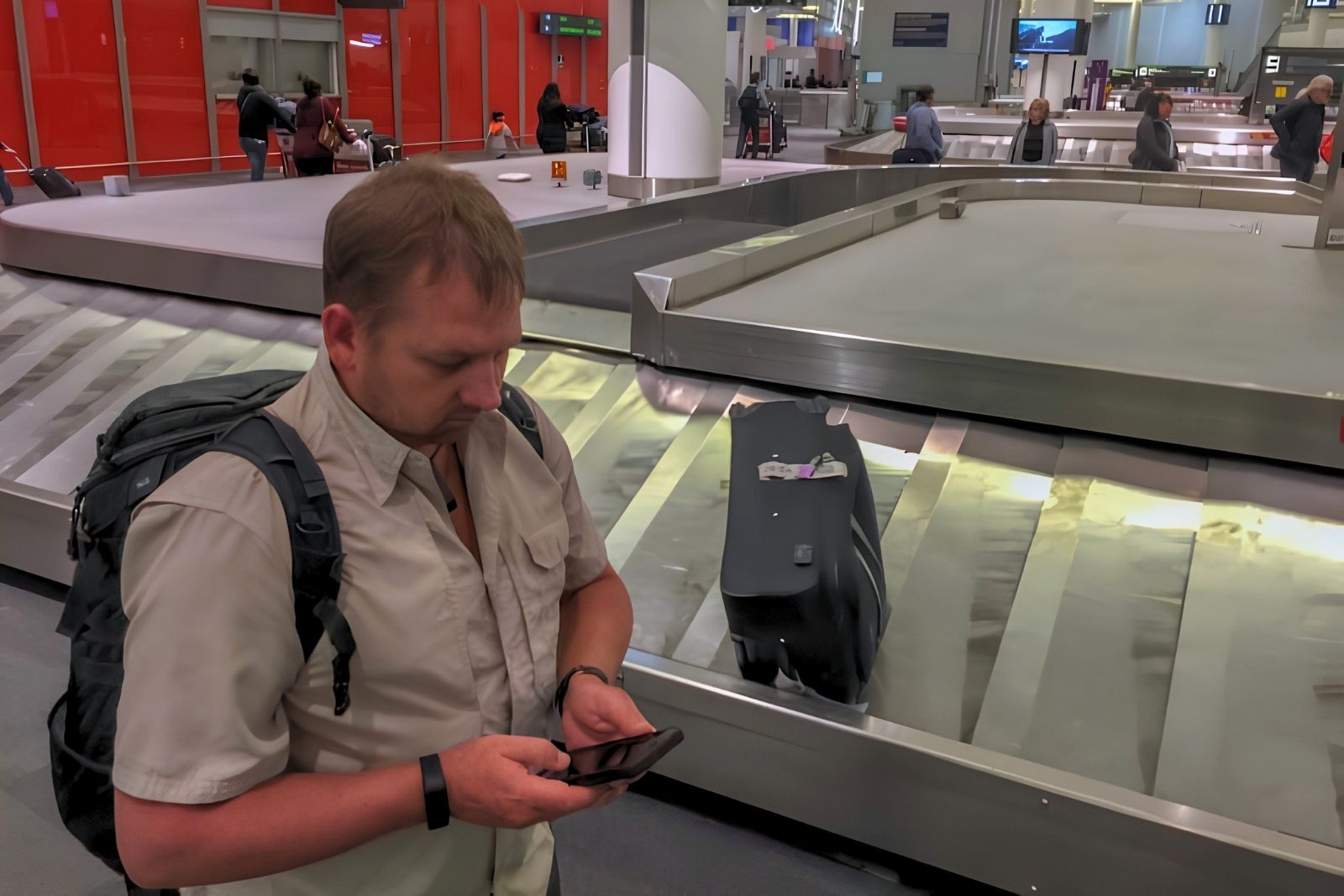
When your bag arrives at the carousel, check it before leaving the airport. If it shows signs of a replaced or retagged label, or if it fails to arrive at all, report it immediately - before you exit the arrivals hall. Once you leave, the conversation becomes exponentially harder.
Where Travelers Get Complacent
International airports handle tens of thousands of bags daily. The scale creates anonymity, and anonymity creates opportunity. Most bags arrive without incident. That statistical normality breeds a reasonable but occasionally costly complacency.
The habit of simply surrendering a suitcase at check-in and collecting it at baggage claim without documentation developed in an era when the main concern was delay or physical theft. Protecting the paper trail - the documented link between your identity and your bag - is a newer consideration, and one that frequent travelers across more than 130 countries and all seven continents are now building into standard pre-departure routines.
Never carry anything inside your bag for another person. This sounds obvious, but airport terminals and departure queues create social moments that lower guard: a fellow traveler who is “overweight” and needs to redistribute, a stranger whose “gift” won’t fit in carry-on. Decline. Your bag is your legal responsibility the moment it checks in under your name.
If authorities question you about a bag that is not yours, stay calm, request legal assistance, and present your documentation immediately. A timestamped video of your bag on the check-in scale, showing a different suitcase than the one being questioned, is a different conversation than a verbal denial with no evidence.
Before You Get to the Airport
The check-in counter is not the only place to prepare. Running through a pre-travel checklist at home - photographing bag contents, confirming tracker battery, noting any wear or distinguishing marks on the exterior - means you are not scrambling in a crowded departure hall.
Luggage trackers have dropped significantly in price and now fit inside most suitcases without adding meaningful weight. The documentation habit, once built into a pre-flight routine, adds no real friction to check-in.
The W5 investigation focused on flights departing from Canada and alleged involvement at Toronto Pearson, but baggage handling operates through similar physical conditions at major transit hubs worldwide. The tag itself - a printed paper slip attached by a loop or adhesive - is not a high-security mechanism. Its integrity depends entirely on the humans who handle it.
What does $0 cost, no special equipment, and roughly 90 seconds produce? A video on your phone, a photo of a tag, a receipt in your pocket. That’s the margin between having documentation and not having it if your name surfaces on the wrong bag at customs.