A Famous Drive Gets a New Kind of Credibility
The Sea to Sky Highway has never needed a ranking to justify itself. The drive north from Vancouver along Howe Sound, past granite walls and coastal inlets, through Squamish and up toward Whistler - it earns its reputation every kilometre. What changes now is who can fully commit to it: electric vehicle drivers, without the low-battery anxiety that used to shadow longer Canadian drives.
A study by iSelect analyzed 48 iconic road trips across six continents, scoring each one on charging infrastructure, route distance, estimated charging cost, and traveller reviews. The Sea to Sky Highway ranked seventh in the world, with a road trip score of 88.15 out of 100. Forty-nine chargers service the 121-mile route, with 100% charger distribution across the corridor, and the estimated charging cost sits at just $4.53 CAD. For a destination this scenically dense, the infrastructure math is unusually generous.
What the Global Rankings Actually Show
Canada placed two routes in the global top ten, which says something about how seriously the country has developed its EV corridors. The Kootenay Highway ranked second worldwide with a score of 99.24, while the Sea to Sky came in seventh. The full top ten puts the Sea to Sky in sharp company: Switzerland’s Gotthard Pass topped the list at 99.81, followed by the Kootenay, then The Deep South in the USA at 95.64, Romania’s Transfăgărășan Highway at 91.93, the Jurassic Coast in the UK at 91.04, and Northern Ireland’s Causeway Coastal Route at 90.75.
The Sea to Sky sits just below that cluster - not because the scenery falls short, but because the route is shorter and more contained than some of its competitors. That compression is actually an argument in its favour. You are not managing range anxiety across hundreds of remote kilometres. The stops are real destinations.
The Route Itself: Vancouver to Pemberton
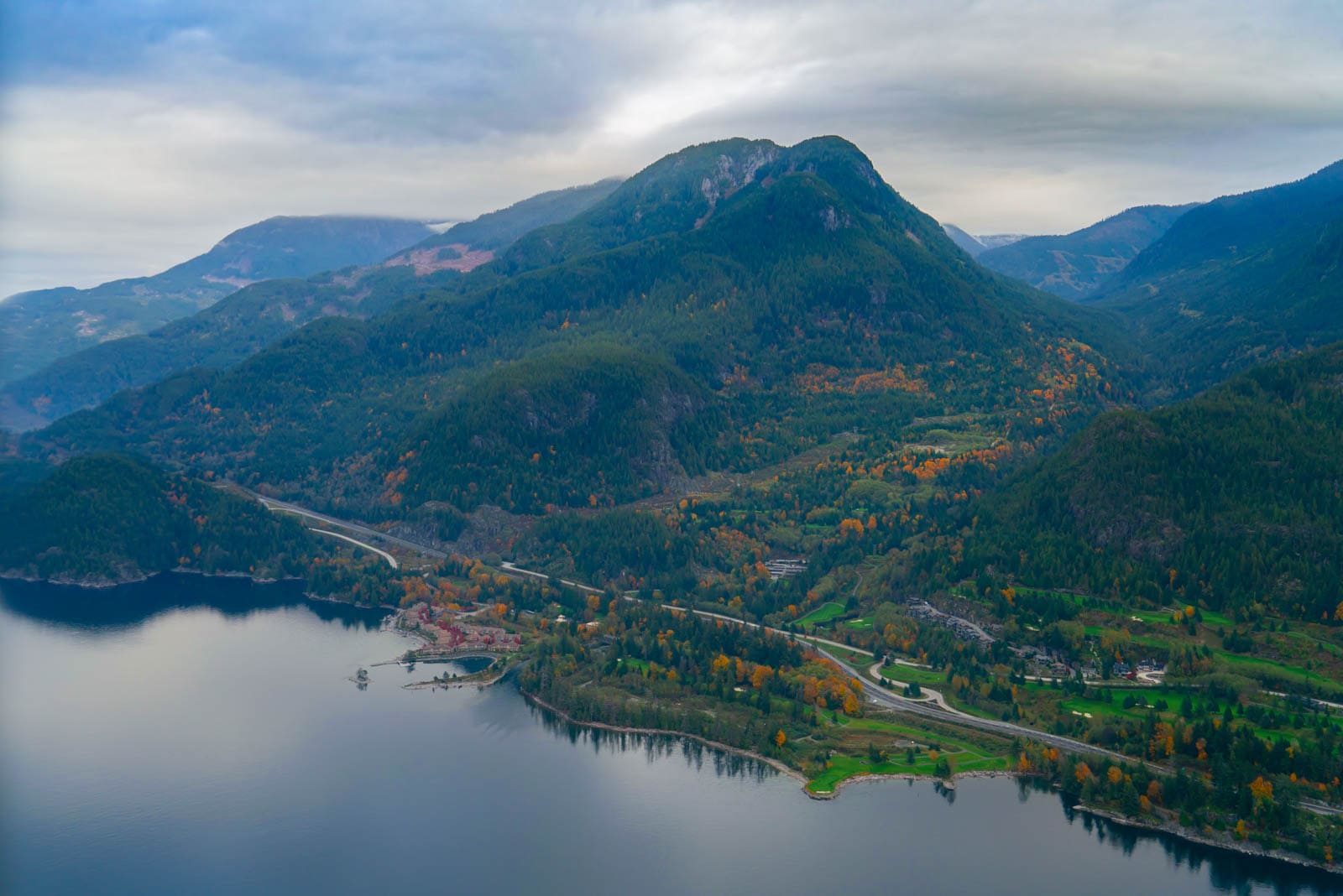
The drive begins at Horseshoe Bay, the terminal point for BC Ferries on the mainland side, where the highway peels north and immediately opens onto Howe Sound. This stretch is the corridor’s quietest argument for itself - the water sits below to the left, the mountains crowd in from the right, and the road follows the shoreline tightly enough that you feel the scale of both.
Shannon Falls arrives early, about 58 kilometres north of Vancouver. The falls drop 335 metres and are visible from a short walk off the highway, making them one of the easiest major waterfalls to reach in British Columbia. Squamish follows, a town that has shifted considerably in the past decade from a forestry base into a destination in its own right, with climbing, mountain biking, and a growing food scene anchored by the Stawamus Chief - a 700-metre granite monolith that defines the skyline as you pass through.
The Sea to Sky Gondola, also near Squamish, ascends 885 metres to a summit viewpoint above Howe Sound. Brandywine Falls, further north near the resort corridor, drops 70 metres and is accessible via a short trail. Whistler sits at roughly the 120-kilometre mark from Vancouver - close enough to Vancouver for a day trip, substantial enough to justify staying. Beyond Whistler, Pemberton marks the northern end of the route, sitting in the Pemberton Valley with the Coast Mountains on three sides and a slower pace than its famous neighbour to the south.
Driving It in an EV
The route rewards EV drivers who plan lightly rather than obsessively. The 49 chargers distributed across 121 miles mean you are rarely far from a top-up, but the terrain matters. The highway climbs significantly between Squamish and Whistler, and elevation gain pulls on battery range in ways that flat-road estimates don’t account for. Cold weather does the same - BC mountain conditions in winter or shoulder season can reduce range by 15–25%, depending on the vehicle.
The practical approach is to charge at activity stops rather than waiting for the battery to demand it. Whistler has multiple charging stations near the village centre, which means a gondola ride or a long lunch can double as a charge. The same logic applies at Squamish, where stops at the gondola base or downtown take long enough to recover useful range. Downloading a charging app - PlugShare works well for this corridor - before leaving Vancouver takes ten minutes and removes most of the guesswork.
A few things to know before you go: do not rely solely on fast chargers, as availability varies by location along the route. Level 2 chargers are more common at destination stops, so building in time at each location - rather than treating this as a point-to-point sprint - keeps the logistics manageable. The route is heavily travelled on weekends, particularly in ski season and summer, which can mean charger queues at peak times in Whistler.
Why This Route Works as a Destination, Not Just a Drive
Most highway rankings evaluate roads as connective tissue - ways to get between places. The Sea to Sky functions differently. Horseshoe Bay, Shannon Falls, Squamish, the gondola, Brandywine, Whistler, Pemberton: each stop is a reason to be there, not just a waypoint. The 121-mile length is short enough to drive in a morning and long enough to fill three or four days if you give each place the time it deserves.
The iSelect score of 88.15 reflects a route that works end-to-end rather than spotily. One hundred percent charger distribution across the route is not a small detail - it means there is no dead zone where you are calculating whether you can make it to the next town.
For travellers already based in Vancouver, this route removes the planning friction that used to make EV road trips feel like a project. The charging cost of $4.53 CAD for the full route is low enough to be irrelevant as a decision factor.
The Broader Shift in EV Travel
The International Energy Agency projected global electric car sales to reach 23 million in 2026, representing 28% of total car sales worldwide. At the end of 2025, the worldwide stock of public charging points exceeded 7 million, with nearly 1.8 million of those added in 2025 alone. The Sea to Sky Highway sits inside that expansion - not as a novelty, but as evidence that certain routes have quietly crossed the threshold into genuinely easy EV travel.
The Kootenay Highway’s second-place global ranking suggests that British Columbia has invested in this infrastructure with some intention. Two routes in the global top ten from a single Canadian province is not coincidence.
The Sea to Sky’s $4.53 CAD estimated charging cost for the full 121-mile route remains the sharpest number in the whole equation.