A Different Kind of Flying Camera
Packing a drone for a trip used to mean paperwork. Most countries draw the regulatory line at 250 grams — anything at or above that weight requires registration, operator certification in some jurisdictions, and a paper trail that can slow you down at customs or on location. The Antigravity A1, released in late 2025, weighs exactly 249 grams with its standard battery installed. That single gram of margin is not an accident.
What makes the A1 worth writing about isn’t just the weight engineering. It’s the capture system underneath it — a dual-lens 360-degree design that records everything around the drone simultaneously, then lets you decide how to frame the shot after you’ve landed.
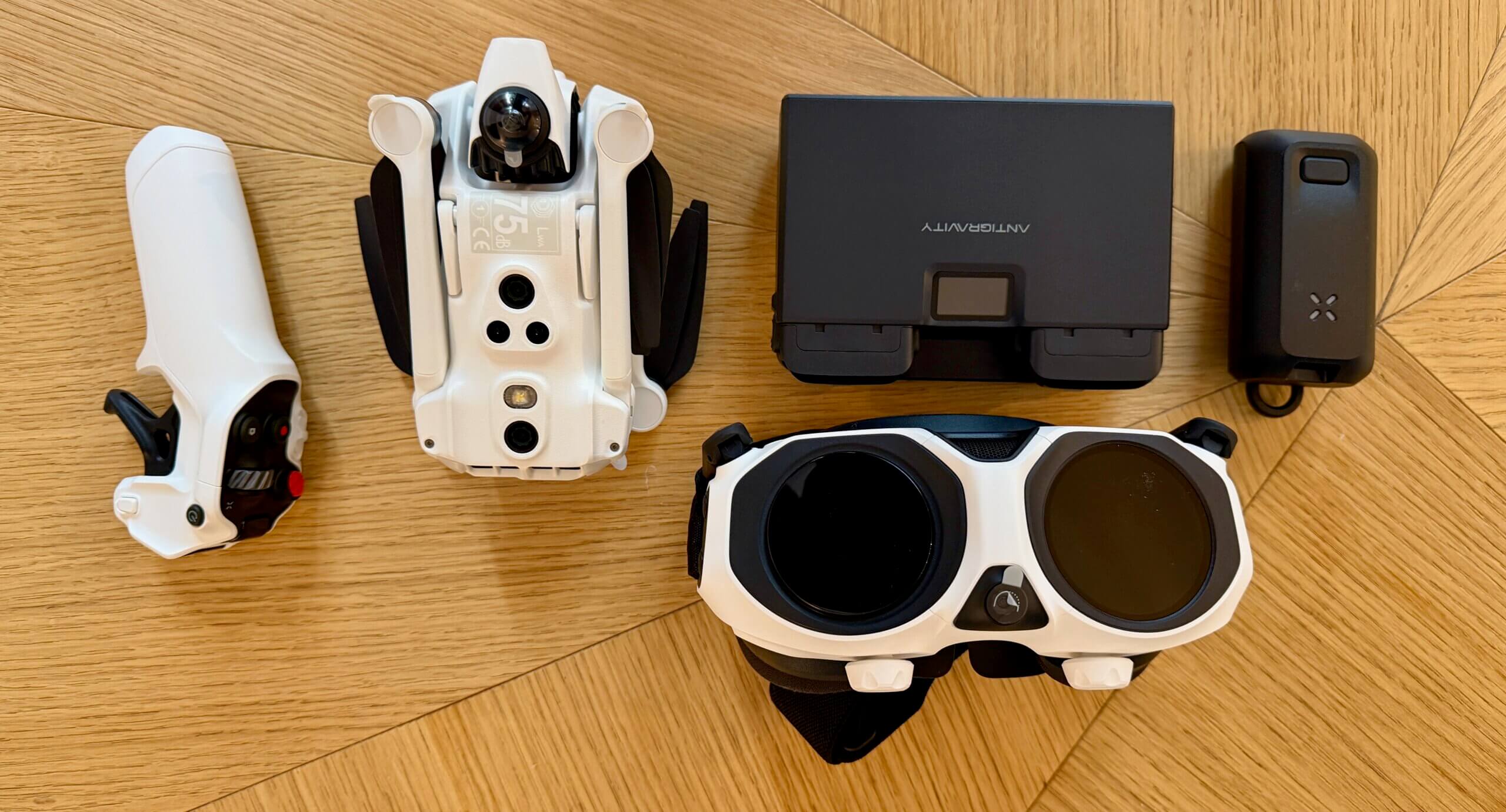
The drone folds down to roughly the size of a large smartphone, though about three times as thick.
Two Lenses, No Gaps
Most drones carry a single forward-facing lens. The A1 runs two ultra-wide-angle lenses instead — one on top of the fuselage, one on the bottom — each covering a 200-degree field of view. The overlap between those two fields produces a complete 360-degree sphere. In exported footage, the drone body is digitally removed, leaving what looks like a camera suspended in open air with nothing holding it up.
The sensors are 1/1.28-inch CMOS units. That’s smaller than the 1-inch sensors on some higher-end photography drones, but substantially larger than what you’d find in a typical 360-degree action camera. The practical difference shows up in two situations that travel shooters encounter constantly: low light and high contrast. Midday sun over white sand or snowfield tends to blow out highlights and crush shadows into black. The larger sensor retains detail at both ends — the texture in a bright sky and the shade under a market canopy in the same frame, simultaneously, without bracketing.
The “8K resolution” figure in the marketing requires a small translation. In a standard camera, 8K means every pixel fills a 16:9 rectangle. In 360 video, those same pixels are stretched across an entire sphere. When you crop that sphere down into a flat, shareable clip — the “reframe” step — you’re working with a portion of those 8K pixels, not all of them. The effective resolution of a reframed clip is lower than 8K. That’s not a flaw specific to the A1; it’s how 360 video math works across every camera in the category. The advantage is flexibility: you can reframe the same flight into multiple different shots, with different subjects, without ever flying again.
Flying It Without Reading the Manual
The Vision Goggles that pair with the A1 use dual 4K micro-OLED displays running at a 120Hz refresh rate. Latency is close to zero in practice. Head tracking is built in, and because the drone is capturing in all directions at once, the goggle feed moves with your head. Look left and the view pans left. Look down and you see the ground passing beneath the aircraft. With a fixed-camera drone, you’re locked to whatever direction the lens is pointing. With the A1, you’re effectively sitting inside a live spherical video, looking wherever you choose.
The motion controller is single-handed. Point it in the direction you want to go, pull the trigger to accelerate, tilt your wrist left to bank. Raise the nose of the controller and the drone climbs. The learning curve is short enough that first-time pilots are navigating complex environments within minutes. A traditional “Mode 2” stick controller is supported for pilots who want manual acrobatic control, but the motion system is fluid enough that most users won’t feel the need.
The body is carbon-fiber-reinforced polymer — not the standard ABS plastic used in cheaper models — which gives it a better strength-to-weight ratio without adding grams. The folding mechanism clicks into place with the kind of tactile precision that suggests the hinges will still be working two years and thirty trips from now.
What the Weight Threshold Actually Means on the Road
The 249-gram figure matters most when you’re moving between countries on a single trip. Drone law varies enormously by destination. In the European Union, drones under 250 grams fall into the “open” category, requiring no registration and no remote pilot certificate for recreational use. The United States sets its FAA registration threshold at the same 249-gram mark — under that weight, recreational flyers are exempt from registration, though some airspace restrictions still apply. Australia, Canada, and the United Kingdom use similar weight-based tiering systems, though the exact rules differ and change; checking the civil aviation authority for each country before you fly remains necessary regardless of what the drone weighs.
The point is not that the A1 is regulation-proof — no drone is, and restricted airspace, national parks, and urban no-fly zones apply regardless of weight. The point is that it clears the most common bureaucratic hurdle before you’ve even reached the border.
For travelers who are already carrying a full camera kit, a laptop, and the miscellaneous gear that accumulates on longer trips, the physical size matters too. The folded A1 fits in a jacket pocket or the top compartment of a backpack. It doesn’t need a dedicated case or a checked bag.
The “Fly Now, Frame Later” Trade-off
The workflow the A1 encourages is genuinely different from traditional drone shooting. With a standard drone, you make your framing decisions in the air — you position the camera before you press record, and what you capture is what you get. With the A1, you fly a path through a location and record everything. The framing decisions happen afterward, in editing software, where you rotate through the sphere and lock down the angle you want.
That’s freeing in some ways. You’re not chasing the perfect position while the light shifts. You’re not missing a moment because the drone was pointed the wrong direction.
It also means the editing step is longer and more deliberate. The 360 sphere contains a lot of footage you won’t use, and sorting through it takes time. Travelers who want fast turnaround — posting the clip the same evening — will need to budget for that extra step.
The A1’s body construction uses high-grade carbon-fiber-reinforced polymer, and the whole package, including the Vision Goggles and motion controller, is compact enough to qualify as carry-on luggage without negotiation.
Before You Pack It
The A1 is a specific kind of tool. It suits travelers who want maximum post-flight flexibility, who are moving through multiple countries and want to avoid the registration process in each one, and who are willing to spend more time in editing in exchange for more options in the final cut.
It is not a replacement for a dedicated photography drone with a large sensor and a precision gimbal, if that’s what your work requires. The 1/1.28-inch sensors are good — genuinely good for the category — but they don’t match the image quality ceiling of a 1-inch sensor in ideal conditions.
What it is, at 249 grams, is the rare piece of travel gear where the engineering and the regulation landed on the same number at the same time.
The standard battery ships with the unit. Replacement batteries are worth packing.