A Drone That Removes Itself from the Shot
The hardest part of aerial photography has never been the flying. It’s the framing — committing to a single direction before you know what the light will do, what a bird might cross through, what the shadow of a cloud will reveal three seconds after you’ve already banked away. The Antigravity A1, released in late 2025, sidesteps that problem entirely by recording everything at once and letting you decide what you were looking at after you’ve landed.
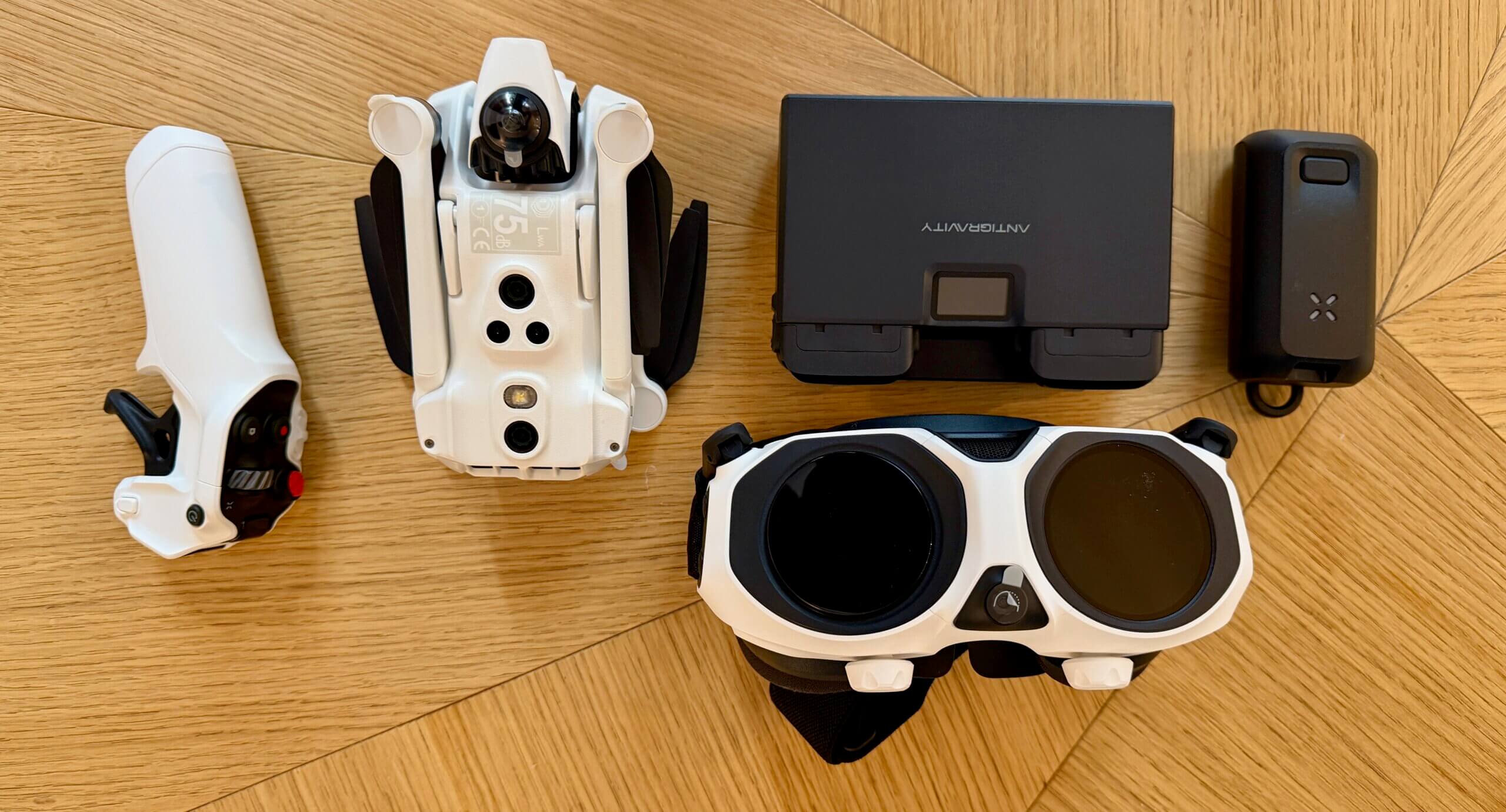
That’s not a marketing summary. It’s the actual operational logic of the thing. Two ultra-wide-angle lenses — one on top of the fuselage, one on the bottom — each capture a 200-degree field of view simultaneously. The overlapping images stitch into a continuous 360-degree sphere. In post-production, the drone’s own body is digitally removed from the footage, leaving what looks like a camera floating in open air with no visible support. The “fly now, frame later” workflow it produces is less like piloting and more like navigating a pre-recorded virtual space.
Why 249 Grams Is Not an Accident
Most countries set 250 grams as the threshold at which a drone becomes subject to formal registration requirements and stricter flight regulations. The A1 was built to weigh exactly 249 grams on its standard battery. That single gram of margin is not incidental — it’s the difference between pulling out a device for a spontaneous coastal shot and spending three weeks filing paperwork before your trip begins.
At that weight, the chassis still manages to feel solid. Antigravity used a carbon-fiber-reinforced polymer rather than the ABS plastic common in cheaper models, which delivers a better strength-to-weight ratio without adding grams. The folding arms click into place with enough precision that it doesn’t feel like a product that will loosen over time. Folded flat, the drone is roughly the size of a large smartphone, though about three times as thick — it fits in a jacket pocket without requiring a dedicated case.
The sensor hardware is worth noting separately. Each lens is backed by a 1/1.28-inch CMOS unit. That’s smaller than the 1-inch sensors on some higher-end photography drones, but considerably larger than what’s found in most 360-degree action cameras. In practical terms, that extra sensor area matters most when you’re shooting in mixed light — the kind of harsh midday contrast you get above open water or desert terrain, where a smaller sensor blows out the sky or loses detail in the shadows below.
Flying It Without Reading the Manual
The A1 ships with optional Vision Goggles — dual 4K micro-OLED displays running at a 120Hz refresh rate. Latency is near-imperceptible. The goggles include integrated head tracking, which is where the 360-degree capture format becomes genuinely strange to use for the first time. Because the drone is recording in every direction simultaneously, the goggle feed doesn’t lock to the drone’s nose. Turn your head left and the feed pans left. Look straight down and you see the ground moving beneath you. It’s a spatial awareness that standard FPV setups can’t replicate.
Control defaults to a single-handed motion controller. Point it where you want to go, pull the trigger to accelerate, tilt your wrist to bank, raise the nose of the controller to climb. The learning curve for this system is genuinely short — complex environments become manageable within minutes for someone who has never piloted a drone before. The A1 also supports a traditional Mode 2 stick controller for pilots who prefer manual acrobatic precision, but the motion controls are fluid enough that most people won’t feel compelled to switch.
What 8K Actually Means in a Sphere
Here the advertising requires some unpacking. The A1 markets “8K Resolution,” which is accurate but means something different in 360 video than in conventional footage. In a standard camera, 8K resolution packs all pixels into a 16:9 rectangle. In 360 video, those same pixels are spread across the interior surface of a complete sphere. When you reframe a section of that sphere into a flat export — which is how most people will actually watch or share the footage — you’re working with a cropped portion of the total resolution. The effective output of a reframed clip will be considerably lower than 8K, depending on how wide a field of view you select.
That’s not a flaw specific to this drone. It’s a fundamental property of spherical video that affects every 360-degree camera on the market. The A1’s sensor size does help recover some of that loss compared to action-camera-based alternatives, and the dynamic range advantage becomes visible in high-contrast environments. But anyone expecting to export 8K flat footage from a reframed 360 clip will need to recalibrate expectations before the first flight.
What This Changes for Travelers
Drone regulations vary so sharply by country that many travelers simply leave their equipment at home rather than research every local rule before departure. The sub-250-gram threshold — recognized in regulations across the European Union, the United Kingdom, Canada, Australia, and a growing number of other jurisdictions — makes the A1 substantially easier to travel with legally than most camera drones currently on the market.
That doesn’t mean it’s unrestricted everywhere. National parks, controlled airspace, and specific urban zones impose rules that apply regardless of drone weight. Flying near airports, stadiums, and certain coastal areas will still require permits or outright prohibition in many places. The weight threshold removes the registration layer, not the airspace layer.
What it does remove is the recurring frustration of arriving somewhere with a drone that technically requires local registration you didn’t complete. That friction alone has kept a lot of aerial footage from ever being shot. The A1’s engineering suggests Antigravity built the product specifically around the constraints of international travel rather than around domestic hobbyist use — which is a different design priority than most competitors in this category have pursued.
The Format Problem Worth Sitting With
360-degree video still doesn’t have a universal home. YouTube and Meta support spherical playback, but most social platforms flatten everything, meaning a carefully captured sphere gets auto-cropped into whatever the algorithm prefers. Reframed flat exports solve part of that problem — you pull the frame you want in post, export it as conventional footage, and post it like anything else. But that workflow adds time, and it requires either desktop software or the companion app to do it well.
The “fly now, frame later” promise holds up as a creative proposition. Whether it holds up as a practical workflow depends entirely on how much post-production time you’re willing to spend on footage from a single afternoon flight. For a travel photographer on a two-week itinerary moving through a new city every other day, that’s a real consideration. For someone shooting a single location repeatedly over multiple trips, the flexibility of reframing becomes an obvious advantage.
The A1 was sent for review use. No retail price was confirmed in available product information at the time of writing — prospective buyers will need to check directly with Antigravity for current pricing before purchase.