Aerial footage has become one of those travel obsessions that’s genuinely hard to argue against — a single overhead shot of a coastline or canyon can do more storytelling work than a dozen photos taken at eye level. The Antigravity A1, released in late 2025, approaches that goal from an unusual angle.
A Drone Built Around One Specific Threshold
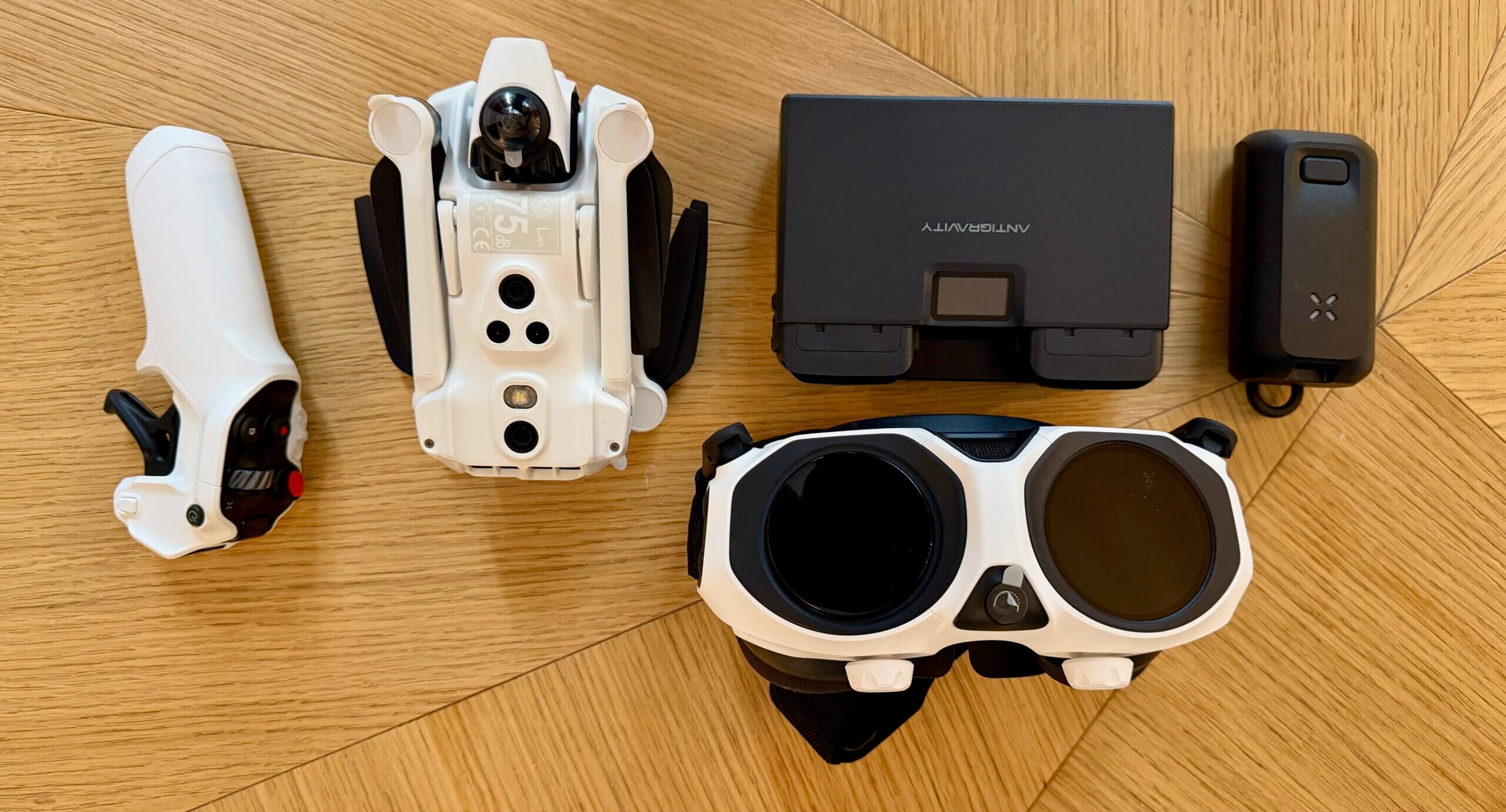
Weight matters enormously in drone travel, and not because of luggage limits. Most countries require drones at or above 250 grams to be registered and subjected to stricter commercial flight regulations. The A1 weighs exactly 249 grams with its standard battery. That single gram of margin is not accidental — it’s the entire product strategy made physical.
That weight is held together with a high-grade carbon-fiber-reinforced polymer rather than the standard ABS plastic used in cheaper models. The difference is noticeable: the strength-to-weight ratio is higher, and the folding mechanism clicks into place with the kind of precision that suggests durability over time rather than just the first few uses. Folded down, the drone sits roughly the size of a large smartphone, though about three times as thick — which means it fits into the kind of bag pocket usually reserved for a battery pack or a paperback.
For travelers who’ve previously avoided drones because of the registration paperwork, the insurance requirements, and the pre-flight bureaucracy that comes with heavier models, the A1’s weight puts it in a genuinely different category.
It is still a drone. Local airspace restrictions, national park bans, and urban no-fly zones apply regardless of what the device weighs. The 249-gram threshold removes one layer of friction — not all of them.
What Two Lenses Change About the Experience
Most drones point one lens forward. The A1 mounts two ultra-wide-angle lenses on the top and bottom of the central fuselage, each capturing a 200-degree field of view. Overlapping those two images produces a complete 360-degree sphere — every direction covered simultaneously, with no moment where the pilot has to choose what to point at.
The practical effect of this on travel footage is significant. The standard problem with traditional drone shots is that you commit to a direction when you launch. If the light changes behind you, or a boat crosses the frame at the wrong moment, or you simply misjudge the most interesting angle from the ground, the shot is gone. With the A1’s 360-degree capture, the framing decision moves entirely into post-production. What Antigravity calls a “fly now, frame later” workflow means the pilot can focus exclusively on flight path and altitude, then return to the footage on a laptop and select the angle, direction, and composition afterward — essentially directing a virtual camera inside a pre-recorded spherical environment.
The sensors powering those two lenses are 1/1.28-inch CMOS units. For context: smaller than the 1-inch sensors found on some higher-end photography drones, but substantially larger than the sensors typical of 360-degree action cameras. In practice, this means the A1 handles the high-contrast lighting conditions that routinely destroy travel footage — direct noon sun over white sand, sunrise over dark water — better than most action cameras in its category. Dynamic range is wider, shadow detail survives, and highlights don’t blow out as aggressively.
The marketing materials display “8K Resolution” prominently, which requires some unpacking. In a standard camera, 8K means every pixel is packed into a single 16:9 rectangle. In 360-degree video, those same pixels are distributed across a full sphere. When you extract a flat, conventionally framed clip from that 8K sphere — which is the actual deliverable most people will use — you’re working with a crop. The effective resolution of that extracted clip is lower than the 8K headline suggests. That’s not unique to the A1; it’s a structural reality of all 360 cameras. Worth knowing before purchase.
The drone itself is digitally removed from the final exported footage, creating the impression of a camera suspended in the air with no visible means of support. For travel content, that particular detail matters more than it might seem — the absence of propeller arms and landing gear in the frame keeps the footage clean.
Flying With Goggles and a Single-Handed Controller
The A1 ships with Vision Goggles: lightweight, with dual 4K micro-OLED displays running at a 120Hz refresh rate. Latency is close to non-existent. The goggles include integrated head tracking, and because the drone is recording in 360 degrees simultaneously, the goggle feed responds accordingly — turn your head left and the feed pans left, look down and the ground appears beneath you. This is a fundamentally different experience from watching a forward-facing camera feed on a phone screen. The spatial awareness it creates is disorienting in the best way on first use.
The motion controller is single-handed. Point it in the direction of travel, pull the trigger to accelerate. Tilt your wrist left to bank, raise the nose of the controller to climb. Within a few minutes of first flight, the controls begin to feel less like operating a machine and more like gesturing at one. For travelers who’ve found traditional twin-stick FPV controllers too steep a learning curve — or too bulky to pack — the motion controller removes most of that friction.
For pilots who prefer manual acrobatic control, the A1 does support a traditional Mode 2 stick controller. Most users will not switch.
What This Actually Means on the Road
The 249-gram weight limit, the compact folded size, the single-handed controller, and the post-production framing workflow all point toward the same traveler: someone who wants serious aerial footage without dedicating significant bag space, pre-trip research hours, or in-country registration effort to getting it.
The A1 is not the right tool for every situation. Photographers who want the absolute best low-light performance or the highest-resolution flat footage will still reach for larger, heavier drones with larger sensors. But for a traveler who wants one device that fits into a jacket pocket, requires no registration in most countries, captures every direction simultaneously, and can be flown by someone without significant drone experience inside of an afternoon — the specs are difficult to argue with. The goggles alone justify serious attention, independent of everything else.
The standard battery configuration brings the drone to exactly 249 grams.