The Problem With Working From the Road
Remote work while traveling sounds clean in theory. In practice, it means crouching over a wobbling café table, burning through a data plan because the hostel Wi-Fi dies every twenty minutes, or messaging an Airbnb host at 11pm to ask, again, why the “high-speed internet” can’t load a Google Doc. These aren’t edge cases — they’re the baseline experience for most people trying to hold down a job while moving through the world. The gap between what travelers need to work and what most accommodations actually provide has been wide for years.
That gap has started to close. Post-pandemic remote work didn’t just normalize location independence — it created enough demand for a new category of accommodation to take root. Coliving spaces now sit between a coworking office and a social hostel, but with private rooms, proper infrastructure, and a deliberate attempt at community. Outsite is the largest operator in this space, with over 50 locations worldwide and more than 5,000 members on its books.
What Outsite Actually Is
Outsite launched in 2015 out of a single house in Santa Cruz, California — a place for people who wanted to surf in the morning and work in the afternoon without sacrificing either. That origin story matters because it explains the ethos: this was never designed to be a corporate retreat or a glorified hostel. It was built around a specific kind of person who refuses to treat work and travel as mutually exclusive.
Today, the platform operates across more than 50 locations. You can filter by destination type — beach, city, mountains — and book a private room directly through their website. Membership is optional but meaningful: a yearly pass costs $199, or you can pay $499 once for lifetime access. Members get a week free in new destinations, 50% off flash sales, 40% off extended stays, access to members-only locations, and invitations to new member mixers. There’s also a job and sublets board, which is genuinely useful if you’re between contracts or looking to stay somewhere longer than a week.
Non-members can still book. But the membership math becomes obvious quickly if you’re planning more than one or two stays a year.
How a Stay Actually Works
Booking an Outsite means booking a private bedroom. Most rooms come with en-suite bathrooms; a smaller number of budget-priced rooms share a bathroom with one other guest. The private room is where the similarity to a hotel ends.
Every property runs on shared, communal infrastructure that would be financially out of reach in a solo rental. Fully-equipped kitchens — the kind with real counter space and actual cookware — are standard. So are spacious living rooms, outdoor patios, and depending on the location, rooftop decks or pools. These aren’t afterthoughts. The communal areas are often the best-designed parts of the building.
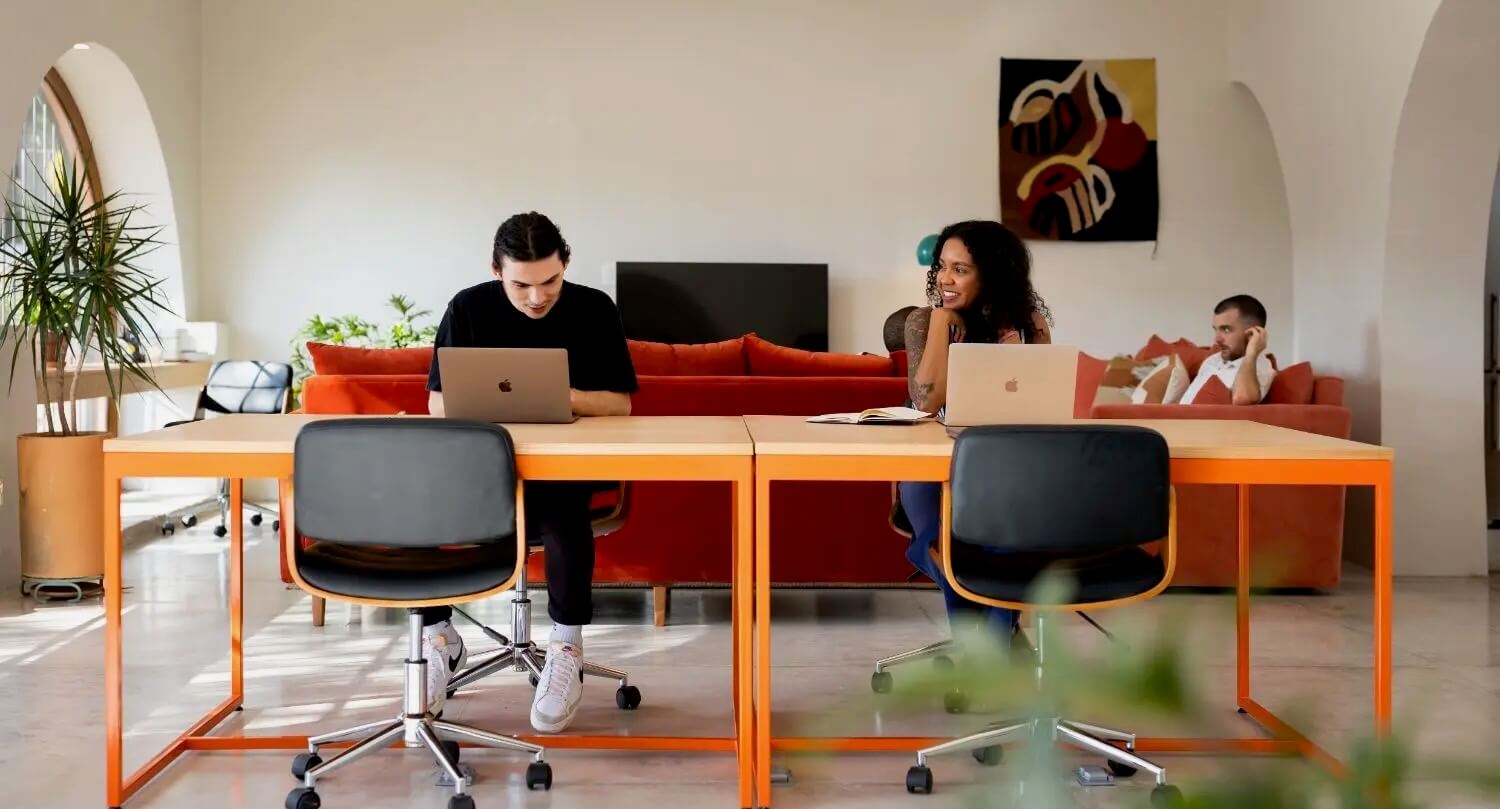
The coworking setup is built into the house itself. Ergonomic chairs, dedicated monitors, plenty of outlets, and enterprise-grade Wi-Fi that doesn’t buckle under the weight of a video call. The practical upside is that your commute to your desk is measured in footsteps, not metro stops.
Each location has a Community Manager on staff. Before arrival, guests are added to a local WhatsApp group, and the manager organizes weekly programming: family-style dinners, morning yoga, weekend group trips, Friday tapas crawls. The calendar isn’t mandatory, but it exists — and it solves a real problem. Solo remote work is isolating by design. A building where other people are doing the same thing, under the same roof, changes the texture of a workday in ways a café cannot.
The Bordeaux Location Up Close
The Bordeaux property demonstrates what Outsite looks like when it’s working well. The space had modern furniture throughout, a small in-house gym, laundry facilities, and a coworking area that didn’t require any adaptation — you could sit down, plug in, and focus without fussing with setup.
The private room had a dedicated desk, a comfortable bed, and a bathroom with genuinely good shower pressure — a detail that sounds minor until you’ve spent a week in accommodations where it isn’t. The Community Manager during that stay was consistently useful: restaurant suggestions, neighborhood orientation, general questions answered without friction.
The Bordeaux location also reflects something true about the platform’s wider approach: the locations are chosen with some care. A wine city in southwest France, where the streets reward slow walking and the evenings are built around long meals, is a sensible place for a coliving space. Work gets done during the day. The city earns its keep afterward.
Who This Is For — And Who It Isn’t
Outsite works best for a specific traveler: someone with location-flexible work, who travels for weeks or months at a time, and who has learned that isolation is one of the harder parts of the nomadic setup. If you’re moving fast — three nights here, two nights there — the community aspect doesn’t have time to develop, and you’d probably do better at a boutique hotel.
For longer stays, the calculus shifts. The membership fee at $199 per year or $499 for life stops looking like an optional add-on and starts looking like the obvious move. The 40% discount on extended stays alone can cover the annual fee in a single booking, depending on the location.
The properties are not cheap at rack rate, which is worth saying plainly. This is not a budget option for travelers trying to keep costs at hostel levels. What it offers is a trade: pay more than a dorm bed, get significantly more than a dorm bed — private room, fast internet, working desk, kitchen access, and a social structure that doesn’t require you to manufacture it yourself.
The platform’s 50-plus locations span multiple continents, covering city and coastal options across Europe, the Americas, and beyond. That range makes it plausible, for a committed long-term traveler, to string together months of stays without repeating a destination.
The Founding Logic, Still Intact
Outsite’s Santa Cruz origin — surf and work, in that order — was a niche idea in 2015. Eight years later, the niche has become a market. The original house has expanded into a global network, but the underlying premise hasn’t been renegotiated: that working remotely from somewhere beautiful is a legitimate way to live, and that the infrastructure to support it should exist.
What the platform gets right is that it doesn’t try to solve everything. It provides the room, the desk, the internet, the kitchen, and the social scaffolding. What you do with a free afternoon in Bordeaux — or Santa Cruz, or wherever you’ve landed — remains entirely your own problem.
The lifetime membership, at $499, is the number that tends to stop people. For context, a single week’s stay at a well-located Outsite property, with the extended-stay discount applied, can run several hundred dollars less than it would at rack rate. The math closes faster than it appears.