The Pacific Crossing That Starts Before You Land
Getting to Melbourne from Los Angeles is not a short commitment. The route spans roughly 7,900 miles of open ocean, and how you choose to cover that distance shapes everything that follows - your first impression of Australia, your body clock on arrival, your willingness to do anything useful on day one. Qantas operates the crossing on an Airbus A380, and while that aircraft is no longer the newest thing in the sky, it remains a practical and often comfortable way to bridge the gap between the U.S. West Coast and one of the world’s most livable cities.
The A380 entered service with Qantas back in 2008, and the airline currently keeps 10 of them flying. That number matters for travelers planning a Pacific trip: these are the jets most likely to appear on the LAX–Melbourne route, and knowing what’s on board - and what isn’t - helps calibrate expectations before you book.
What a Business-Class Seat on This Route Actually Costs
A one-way business-class ticket from Los Angeles International Airport (LAX) to Melbourne Airport (MEL) runs between $4,600 and $5,800 depending on travel dates and availability. That’s a significant outlay for a single flight, which makes the points-and-miles alternative worth understanding in real numbers.
Three frequent-flyer programs offer award redemptions on Qantas long-haul business class, and the pricing differences are steep. Alaska Airlines Atmos Rewards prices the LAX–MEL one-way at 85,000 points plus $36 in taxes. American Airlines AAdvantage comes in slightly cheaper at 80,000 miles plus $24. Qantas’ own Frequent Flyer program charges 151,800 points plus $364 - more than double the miles and nearly ten times the fees of the American option. On paper, AAdvantage wins. In practice, the right answer depends entirely on which points you already hold.
Alaska Airlines is a 1:1 transfer partner of Bilt, and Marriott Bonvoy transfers to Alaska at a 3:1 ratio. For travelers who want to build Alaska Atmos Rewards points quickly, the Atmos Rewards Ascent Visa Signature, the Atmos Rewards Summit Visa Infinite, and the Atmos Rewards Visa Signature Business Card are the fastest routes. American miles accumulate through the Citi/AAdvantage Platinum Select World Elite Mastercard, the Citi/AAdvantage Executive World Legend Mastercard, and several other cobranded Citi products. One timing note worth flagging: Capital One ran a 20% transfer bonus to Qantas Frequent Flyer during one recent booking window, which would have reduced that 151,800-point requirement to 121,440 - a meaningful discount that can shift the calculus when bonuses are active.
What You’re Getting Onboard
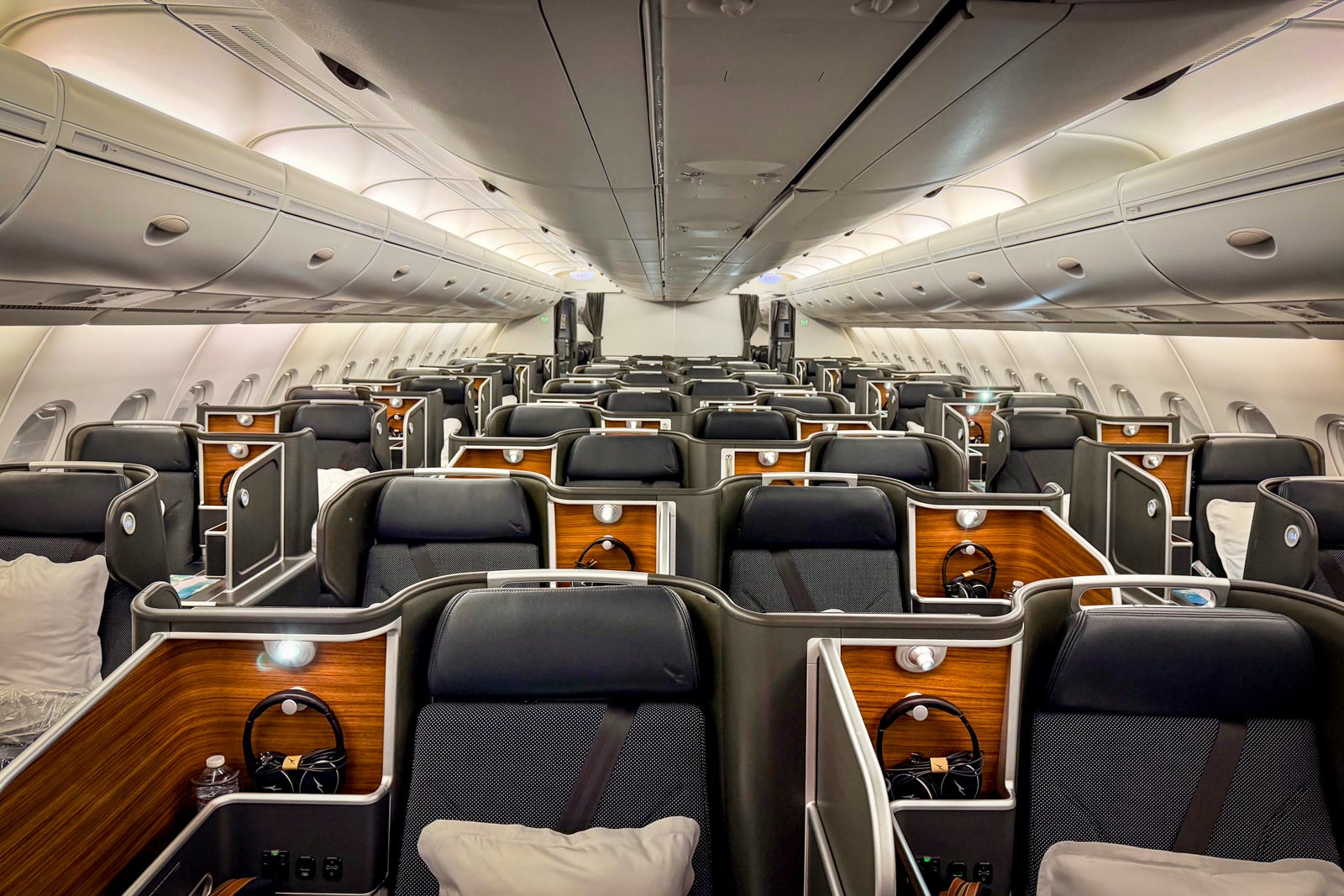
Qantas business class on the A380 delivers on the fundamentals. The seats have enough privacy for a long overnight flight, and the configuration means most passengers aren’t climbing over a neighbor to reach the aisle. Comfort on a 15-plus-hour crossing is not a trivial concern, and the seats hold up.
The in-flight menu is extensive, with enough variety that even passengers with specific dietary preferences can usually find options worth eating. Meal service across a cabin this large does take time - the A380 carries a lot of people, and business class is no exception - so ordering early or being patient with the second round of service both help.
What sets the Qantas A380 experience apart is the onboard lounge. It’s not a full bar in the Emirates sense, but it’s a dedicated social space where passengers can stretch, sit differently, and have a drink without disturbing their seatmate. On a flight this long, the psychological value of moving to another part of the plane is real. It’s a feature that genuinely changes the texture of the crossing.
Then there’s the pajama situation. Qantas business class comes with kangaroo-print pajamas, and they are, by any reasonable measure, a highlight. They’re comfortable enough to actually sleep in, and sufficiently Australian in character that they make reasonable souvenirs of the journey itself.
The Thing That’s Missing
There is no Wi-Fi.
That is not a soft limitation or a coverage gap - it is the current state of Qantas’ A380 fleet on this route. Passengers boarding in Los Angeles will land in Melbourne without having sent an email, checked a message, or uploaded anything. For a 15-plus-hour flight in 2025, this is the most significant complaint against the product, and it’s a real one. Business travelers crossing the Pacific on work schedules will need to build offline contingencies. Download everything before boarding.
Melbourne as the Other Half of the Equation
The flight is one part of the trip. Melbourne is the other, and it deserves its own accounting. The city sits in the state of Victoria in southeastern Australia, roughly 500 miles from Sydney - a comparison that comes up constantly and matters less the longer you stay. Melbourne has a distinct character: a grid-based CBD that opens into lane-way café culture, a serious food scene built on immigration waves from Greece, Italy, Vietnam, and Lebanon, and a tram network that makes the inner city genuinely navigable without a car.
Melbourne Airport sits about 14 miles northwest of the city center. The SkyBus runs directly to Southern Cross Station in the CBD and costs around $32 AUD one way. A taxi or rideshare to the center runs roughly $50–$75 AUD depending on traffic, which on the Tullamarine Freeway during peak hours can add considerable time to either estimate.
Accommodation in Melbourne spans a wide range. The CBD has international chains at every price point, while neighborhoods like Fitzroy, Collingwood, and South Yarra offer smaller boutique options closer to the food and bar precincts that make the city worth exploring on foot. High season for tourism runs roughly December through February, when Melbourne’s summer overlaps with school holidays and major events including the Australian Open tennis tournament, held annually at Melbourne Park in mid-to-late January. Hotel rates during the Open week climb sharply, and booking months in advance is the only reliable mitigation.
The Practical Question Behind the Booking
Award availability on Qantas is limited. This is the least surprising fact in the article, but also the most operationally important. Seats exist, but they don’t appear in large numbers or far in advance, and the LAX–MEL route is competitive enough that flexibility on dates makes a meaningful difference in what you can find and when.
The cash price of $4,600 to $5,800 one-way sets the ceiling on what it’s worth spending in time and points-transfer fees to secure an award. Against that number, 80,000 AAdvantage miles plus $24 is a strong redemption - provided the miles are already in the account and a seat is actually available on the dates that matter. That last condition is the one that causes the most friction, and it’s the reason experienced points travelers monitor availability over weeks rather than hours.
The kangaroo pajamas, it should be noted, are included in the cash price too.